Insects are the most species-rich and ecologically consequential group of animals in Canadian gardens. They pollinate flowering plants, decompose organic material, control pest populations, and form the base of the food web that supports birds, amphibians, and small mammals. Despite this, most garden insects go unidentified — or are treated as undifferentiated pests.
This guide covers the insect groups and species most frequently encountered in Canadian residential gardens, with identification notes and context for their ecological role.
Butterflies
Monarch (Danaus plexippus)
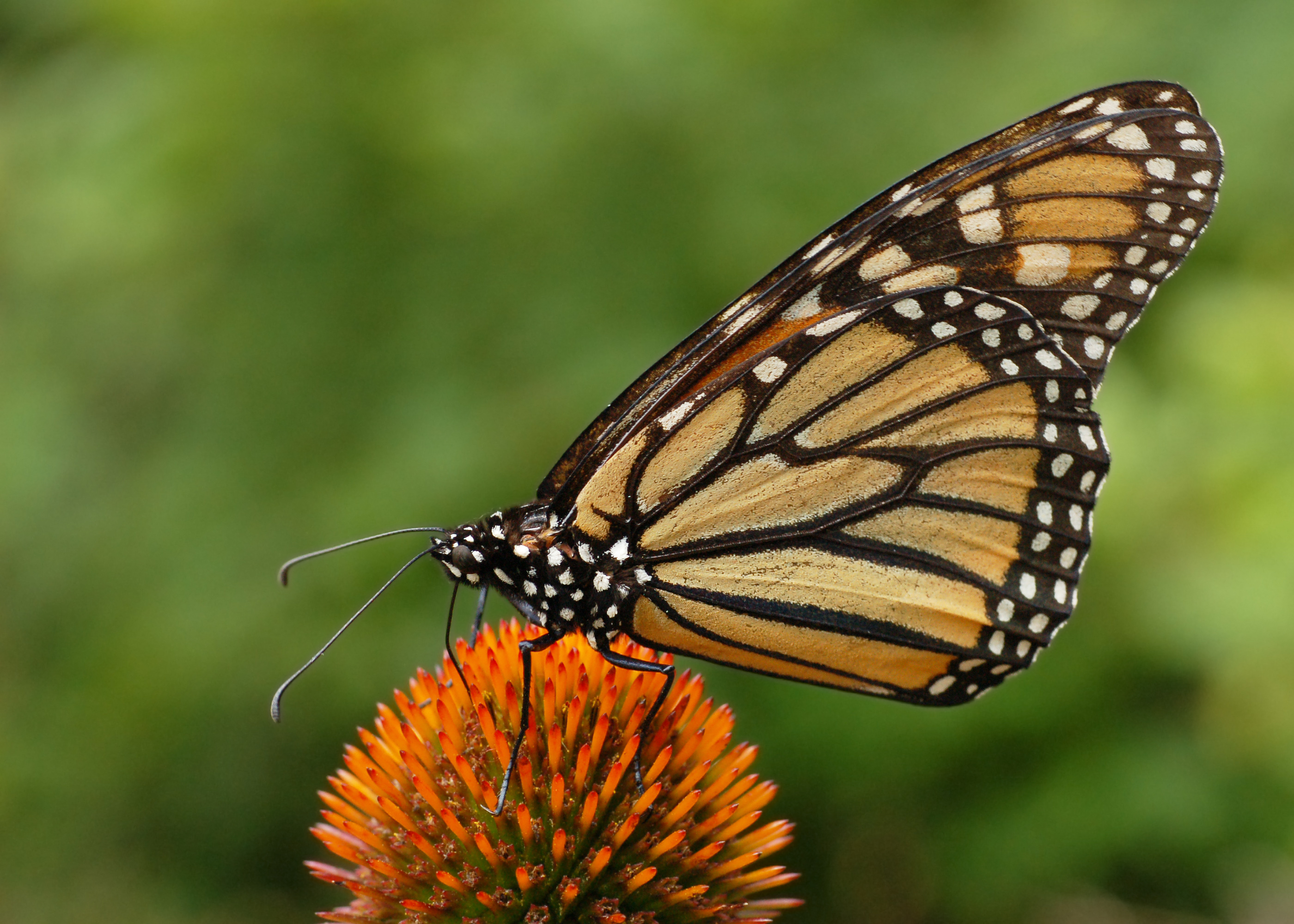
The Monarch is Canada's most recognizable butterfly, with orange wings crossed by black veins and edged with a black border dotted with white. Adults arriving in southern Ontario and Quebec in May and June lay eggs exclusively on milkweed (Asclepias spp.). Caterpillars feed on milkweed foliage, sequestering toxic cardiac glycosides that make both larva and adult unpalatable to most predators.
Monarchs complete two to three generations in Canada before autumn migration carries the final generation to overwintering sites in the mountains of central Mexico — a journey of up to 4,500 kilometres. The species is listed as Special Concern under Canada's Species at Risk Act, reflecting population declines linked to milkweed loss and habitat change along the migration corridor.
How to distinguish from Viceroy: The Viceroy (Limenitis archippus) mimics the Monarch closely but has a black postmedian line crossing the hindwing — absent in the Monarch. Viceroys are also slightly smaller and have a different flight pattern, with more rapid wingbeats and shorter glides.
Eastern Tiger Swallowtail (Papilio glaucus)
Large and striking, the Eastern Tiger Swallowtail is common in Ontario and Quebec from May through August. Males are yellow with black tiger stripes and blue iridescence on the hindwing; females occur in both yellow and dark (melanic) forms. The dark female form mimics the poisonous Pipevine Swallowtail, which is less common in Canada but occurs in overlap zones.
Larval host plants include wild cherry (Prunus spp.), tulip tree (Liriodendron tulipifera), and ash (Fraxinus spp.). Adults visit a wide range of flowers for nectar, with a preference for large-flowered species including milkweed, wild bergamot, and Joe Pye weed.
Cabbage White (Pieris rapae)
One of the most frequently seen butterflies in Canadian gardens, the Cabbage White is actually an introduced species from Europe. It arrived in Quebec in the 1860s and spread rapidly across the continent. Adults are white with one (female) or two (male) black spots on the forewing. Larvae feed on plants in the mustard family, including garden brassicas, and can be damaging in vegetable gardens. Despite its introduced status, it is now thoroughly integrated into urban insect communities and visited by native parasitoid wasps.
Bees
Bumblebees (Bombus spp.)
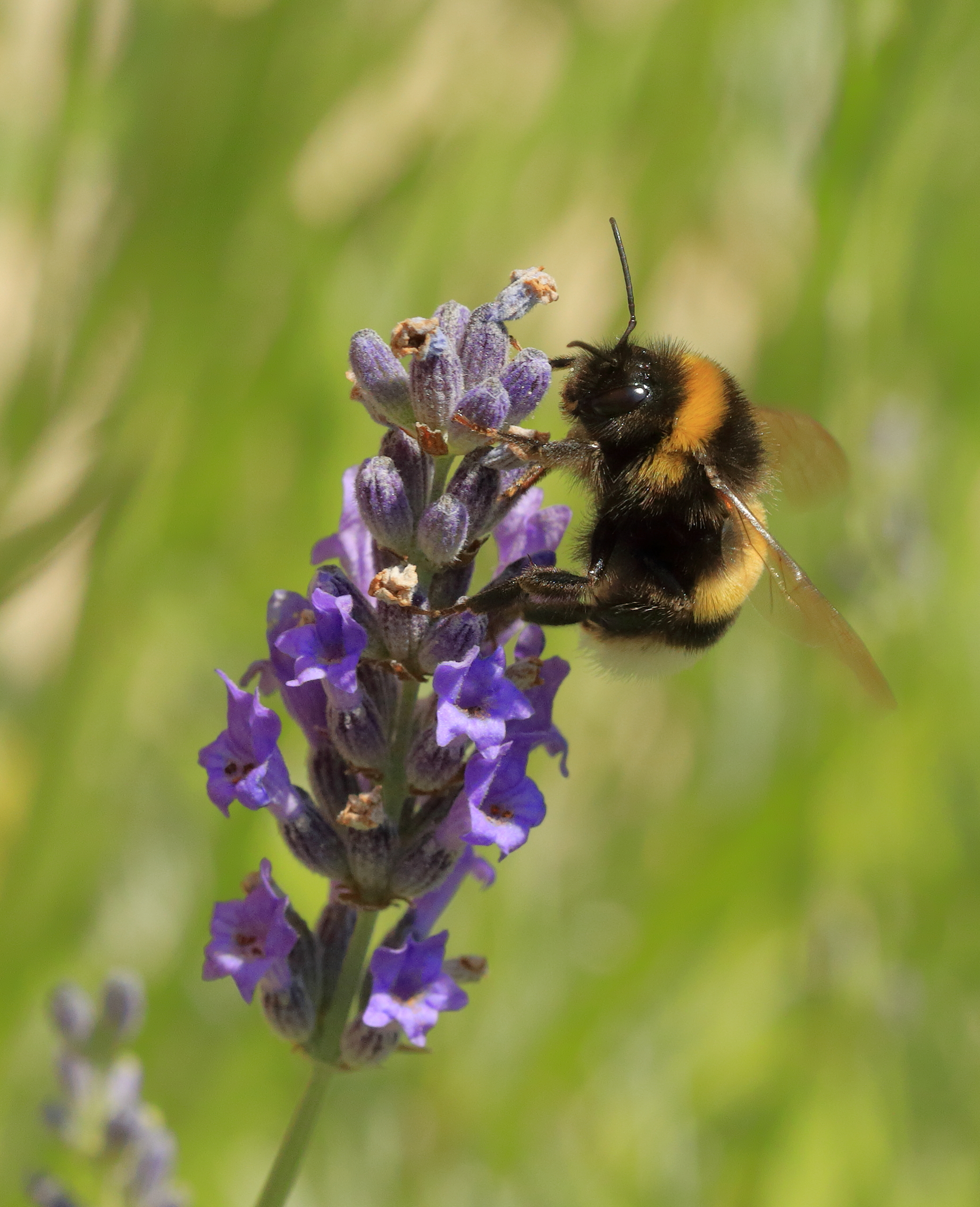
Canada has approximately 44 native bumblebee species, though regional diversity varies considerably. Bumblebees are robust, fuzzy, and typically marked with yellow and black bands, though the precise pattern varies by species. Unlike honeybees, bumblebees are native to North America and nest in the ground or in cavities such as old mouse burrows and hollow logs.
Several bumblebee species have experienced significant range contractions over recent decades. The Rusty-patched Bumblebee (Bombus affinis) is listed as Endangered under Canada's Species at Risk Act and was once common across southern Ontario and Quebec. Its decline is linked to pathogen transmission from commercially reared bees, pesticide exposure, and habitat loss.
Mason Bees (Osmia spp.)
Mason bees are solitary cavity nesters — they do not form colonies or produce honey. Females provision individual nest cells with pollen and nectar, then seal each with mud. Several native Osmia species are active in early spring before most bumblebee queens have emerged, making them particularly important pollinators for early-blooming fruit trees and spring native wildflowers.
Orchard Mason Bee (Osmia lignaria) is present across much of southern Canada. It can be encouraged by providing bundles of hollow stems (bamboo, hollow elderberry canes) or drilled blocks of untreated wood with hole diameters between 6 and 8 mm, mounted facing east or south-east at eye level.
Common Garden Insects Reference
| Group | Common Species in Canada | Identification Notes | Ecological Role |
|---|---|---|---|
| Butterfly | Monarch, Tiger Swallowtail, Cabbage White, Black Swallowtail | Wing pattern, body size, flight style | Pollination, prey for birds |
| Native Bee | Yellow Bumblebee, Two-spotted Bumblebee, Orchard Mason Bee | Hair density and colour bands, body size, nesting behaviour | Pollination, soil aeration |
| Hoverfly | Syrphus spp., Episyrphus spp. | Bee/wasp mimics with hovering flight; no waist constriction | Pollination, aphid control (larvae) |
| Ground Beetle | Carabus spp., Pterostichus spp. | Dark, shiny, fast-moving; found under stones and mulch | Predation of slugs, aphids, small invertebrates |
| Lady Beetle | Seven-spotted Ladybug, Convergent Lady Beetle | Round, domed; variable spot count and colour | Aphid predation |
Hoverflies: Bees That Aren't Bees
Hoverflies (family Syrphidae) are among the most common insect visitors to garden flowers, yet are frequently misidentified as bees or wasps. They are true flies (order Diptera) — they have only two wings where bees have four, and cannot sting. Many species display convincing bee or wasp mimicry with yellow and black banding, and they hover motionless over flowers before landing.
Hoverfly adults feed on nectar and pollen; some larvae feed on aphid colonies, making them both pollinators and biological pest controls. Several dozen species occur commonly in Canadian gardens through summer.
Supporting Garden Insect Diversity
Several practical approaches increase the variety of insect species using a garden space:
- Extend the bloom season: Early spring ephemerals (Bloodroot, Spring Beauty) and late-season plants (goldenrod, asters) support pollinators when mid-season flowers are unavailable.
- Reduce lighting: Outdoor lighting disrupts nocturnal insects including moths, which are important pollinators and prey for bats and nightjars. Motion-activated or amber-spectrum lighting reduces this impact.
- Leave leaf litter: Many species overwinter as eggs or pupae in leaf litter. Removing all leaves in autumn eliminates these populations. A layer of unshredded leaves in planting beds provides overwintering habitat.
- Reduce pesticide use: Even pesticides applied to target pest species affect non-target insects including pollinators and natural enemies of pests. Identifying the actual cause of plant damage before applying any treatment avoids unnecessary impacts.
- Create bare soil patches: Many ground-nesting bee species require areas of bare, compacted soil in sunny positions. A small patch of bare earth in a sheltered spot provides nesting sites that most gardens lack.
Resources for Insect Identification
- iNaturalist — community identification platform
- Species at Risk Registry — Environment Canada
- NatureWatch Canada